

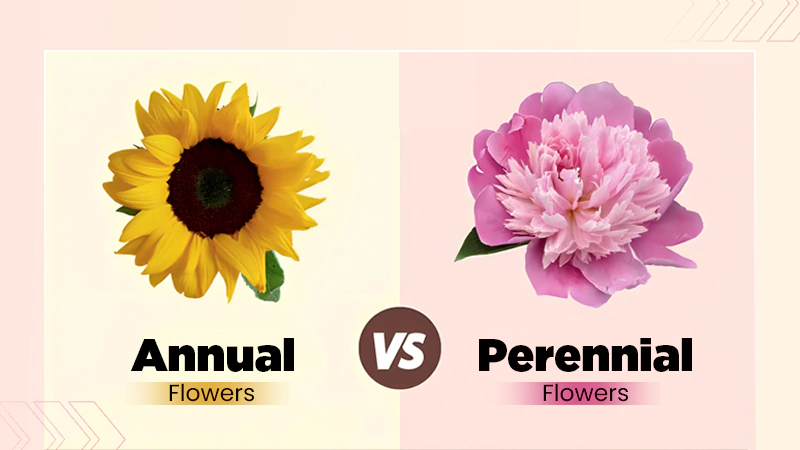
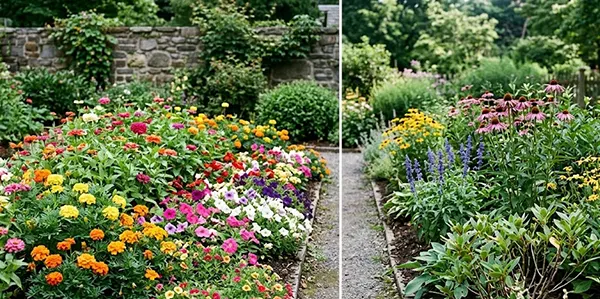
Whenever I visit the plant nursery or search for plant seeds online, I commonly see terms like “annual” and “perennial.” These terms are actually crucial to understanding the plant’s lifecycle and how they are going to fit into your gardening ritual. Interestingly, there is a third category also named “biennial” flowers.
If you are wondering which plant to choose to build a pollinator-friendly garden, keep reading this article, which includes all the necessary information to understand annual vs. perennial flowers.
QUICK ANSWER
Annual flowers have a lifecycle of one growing season, but perennials can grow for several years. Besides the lifespan, these two differ from each other based on features like cost, maintenance, blooming, replanting, root system, and growth speed.
Annual Flowers: One-Season Wonders
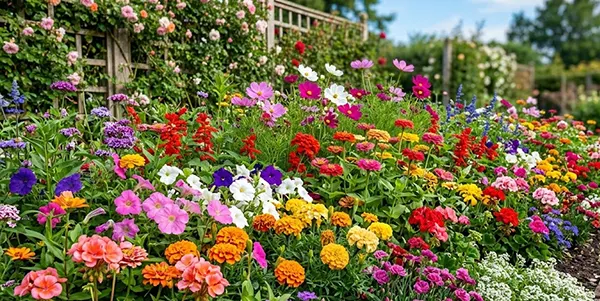
Annual flowers are one-season wonders. They complete their entire cycle within one growing season: they grow, bloom, produce seeds, and die.
If you want to see these flowering plants for home gardens blooming in the next season, you must sow fresh seeds again. These plants are famous among gardeners because they produce abundant flowers throughout the season.
Life Cycle of Annual Flowers
The lifecycle of annuals is usually about 2 to 8 months, depending on the flower variety. The process begins with seed germination and ends when the plant dies naturally.
Let’s see the stages of its life cycle:
- Seed germination: A dry seed absorbs water, swells, and breaks open. The root system develops, and a tiny shoot pushes open toward the sun.
- Seedling growth: The tiny plant is called the seedling. The roots spread, and new leaves emerge.
- Leaf development: Now, the plant will get stronger and make many new green leaves. The stem also gets thicker.
- Flower formation: As it gets mature, its bud produces flowers.
- Pollination: Insects, wind, and birds move pollen between flowers, which is called pollination.
- Seed production: Flower petals fall off as seed pods or new seeds form in the fading flower.
- Plant dies naturally: The parent plant dies as winter comes or dry weather arrives.
Types of Annual Flowers
| Types | Key Points |
| Hardy or cool season annuals |
|
| Tender or warm season annuals |
|
| Half-hardy annuals |
|
Pros and Cons of Annual Flowers
- Long blooming season: These plants have a long blooming season. Most of the varieties keep producing flowers even in the extreme summer heat or cold weather.
- Great design potential: They have great design possibilities as plant breeders develop new annual flower varieties every year. You may easily find double flowers, rare colours, bi-colour blooms and giant flower varieties.
- Rapid growth: Most of the flowers have a fast growth rate. Some even start flowering within 45 to 60 days of sowing the seeds.
- Budget-friendly: These plants cost much less. A small packet of seeds can produce dozens or hundreds of flowering plants.
- Need replanting every year: These plants complete their lifecycle in one growing season. So, it’s necessary to sow the seeds every year.
- More garden work: In these plants, garden beds need preparation every season. You have to remove the old plants before sowing the new seeds, which involves a lot of work.
- Higher water requirement: As these plants grow quickly and flower abundantly, they need more water.
QUICK ADVICE
Annuals require occasional care – make sure to utilize fertilizer for energy and regular pruning to keep blooming. Make a schedule and set reminders, so you never forget!!
Perennial Flowers: Everlasting Beauties
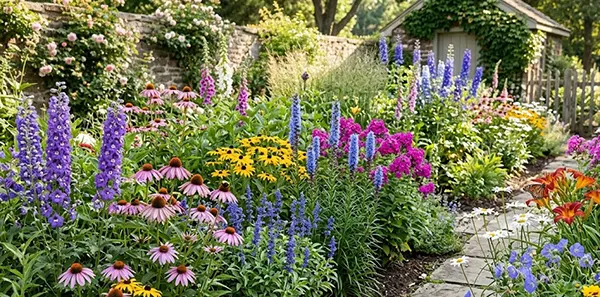
Perennials are cold-hardy plants that live for more than two years. Most of them bloom for one season each year, either spring, summer, or fall. But there are reblooming and long-blooming perennials as well, for example, fern-leaved bleeding hearts.
When kept in proper growing conditions, the perennials can live for many years. The lifespan is dependent on the flower variety; some may live for three to five years. Their care measures also vary greatly; some may thrive on neglect while others need regular pruning to keep their structure.
How Do Perennials Grow?
After each flowering season, instead of dying, the perennials enter the stage of dormancy. During this time, the leaves of the plants may get dry, growth is slow, and roots stay alive underground. When the ideal weather returns, the plant starts growing again. This cycle keeps on repeating for many years.
Common Perennial Flowers
Some famous perennial flowers are:
- Rose
- Hibiscus
- Aparajita (Butterfly Pea)
- Rain Lily
- Bougainvillea
- Chrysanthemum
- Ixora
- Jasmine
- Plumeria
- Pentas
- Adenium
- Lantana
- Geranium (in suitable climates)
- Daylily
- Canna Lily
Pros and Cons of Perennials
- Strong root system: Perennials develop deeper roots, which help plants survive dry periods better.
- Low maintenance: As the roots get established, the plant needs less watering, fewer fertilizers, and less soil preparation. This is ideal for busy gardeners.
- Good for pollinators: Since these plants return every year, they work as a food source for various pollinators like bees, butterflies, native pollinators, and beneficial insects.
- Saves money over time: Though these plants are generally costly, they keep on growing year by year. This makes it a budget-friendly one-time investment.
- Slow blooming: Some plants take about 1-2 years before blooming optimally.
- Flowers for a short period: These plants bloom for a shorter duration compared to others.
- Needs regular maintenance: Some of the varieties require regular pruning, division, or seasonal care to encourage healthy growth.
QUICK ADVICE
Always Remember – “First year they sleep, second year they creep, third year they leap!”
This is the classic gardener’s rule for Perennials.
Annual Vs. Perennial Flowers: Key Differences
It is easy to say that the main difference between Annuals and Perennials is “How Long Do Flowers Last?”. That is incorrect. It is also a matter of costs and maintenance.
Let’s see the key differences between annual and perennial flowers:
Quick Comparison Table of Annuals and Perennials
| Feature | Annuals | Perennials |
| Lifespan | One season | Many years |
| Blooming | Longer | Seasonal |
| Replanting | Every year | Not every year |
| Cost | Lower initially | Higher initially |
| Maintenance | Moderate | Low after the establishment of roots |
| Growth speed | Fast | Moderate |
| Root system | Shallow | Deep |
| Best for | Instant colour | Long-term gardens |
Lifespan
Annuals have a lifespan of one growing season, from the germination of the seeds to the end of plant life. You have to sow the seeds every year if you want to see them growing for multiple seasons.
On the other hand, perennials enter dormancy after every flowering season and regrow themselves as the preferred weather comes back for about three to five years.
Blooming
Annuals generally bloom all season long from spring or late summer through the first frost with heavier flowering. Perennials have a shorter bloom window for a few months or weeks.
Replanting
As annuals complete their lifespan in one growing season, they must be pulled out and replanted from new seeds every year. Perennial flowers live for multiple years. They go dormant or die back to the ground in winter and regrow each spring season from the same roots. As a result, you do not need to replant them every year.
Cost
With Annuals, you must repurchase them every spring to keep the lush display of colours, creating a repeating line pattern in your garden budget. Whereas with Perennials, though carrying a higher buying price, eliminates the future costs by multiplying in size while lasting decades.
Thus, though annual flowers can be bought at a lower price compared to perennial flowers, on a long-term basis, perennials are a better money-well-spent decision.
Maintenance
Annuals need frequent feeding and regular watering all season long as they are fast-growing and heavy bloomers. They also need deadheading to encourage blooming and complete removal of the plant after the growing season.
Perennials usually need deep watering until their roots get established. Once their roots are well established, they can thrive on minimal feeding and occasional watering. These plants also need pruning of dead winter growth and division of root clumps to support healthy growth.
Growth speed
Annual plants grow fast as they have to finish their entire lifespan in one growing season. On the other hand, perennials grow slower as they have to develop stronger roots to live for many years to come.
Root system
Annual plants have a shallow, fibrous root system, while perennials have a stronger, deeper, and denser root system.
Best for
As annuals bloom more profusely, they are great for adding a short-term pop of colour in the garden. Perennials work for long-term gardens better as they do not need replanting for several years.
What are Biennials?
Many people tend to confuse perennials with biennials, though they both are different. Biennials take 2 years to complete their growth cycle before dying. Usually they don’t bloom until the second year, but some may behave like the short-lived perennials and flowers in their first year. Some biennial flowers are dianthus, foxglove, and hollyhock.
Final Verdict
Asking which you should choose in annual vs. perennial flowers is purely a matter of your convenience. Choose the annual flowers if you want seasonal colour pops, faster results, and affordable seeds. Go for perennial varieties if you want long-term design and low maintenance.
What are the easiest flowers to grow for beginners?
Marigolds, Zinnias, and Sadabahar (Periwinkle) are the easiest flowers for beginner gardeners.
Which type of plant is more cost-effective?
Annual flowers can be bought at a lower price compared to perennial flowers, but on a long-term basis, perennials are a better-spent money decision.
What does “deadheading” mean?
The repetitive art of tricking annual flowers into blooming throughout the season is called ‘deadheading’. It is where you either cut old or dead flowers from the stem, or pinch the stem tips with your fingers to redirect their energy towards producing new flowers.
How should I mix annuals and perennials in my garden?
In many gardens, annuals in containers or flower boxes are used to mark borders and brighten pathways. Meanwhile, perennials serve to stabilize the structure of the landscape as they return year after year and are low-maintenance.
- Complete guide to perennials – BBC Gardeners’ World Magazine
- Annuals and biennials – Gardening – BBC
- Pruning perennial and annual flowers – BBC
- Annual – Britannica