

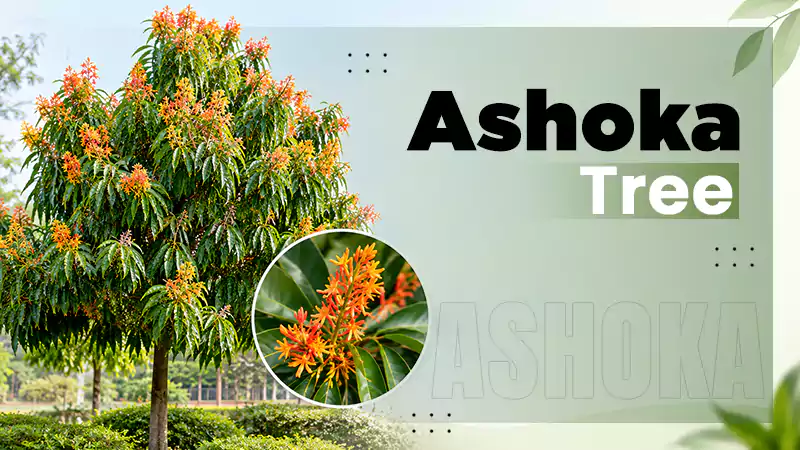
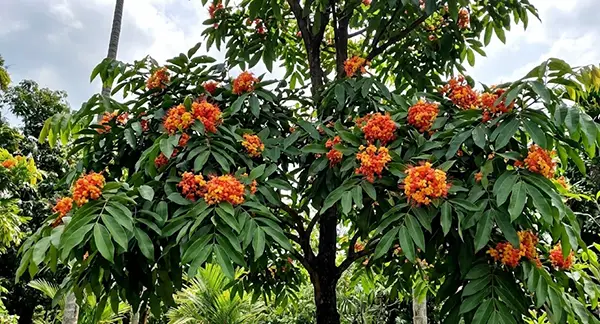
The ashoka tree, which literally means “sorrow-less,” is one of the best flowering plants for home gardens. Belonging to the legume family, this tree is famous for bringing calmness and liveliness into the space. It is a rainforest tree that is highly valued for its erect, tall structure and vibrant leaves and foliage.
If you want to add beauty and serenity to your garden, keep reading this article to grow an ashoka tree and learn about its types and benefits.
Ashoka Tree at a Glance: A Quick Info Box
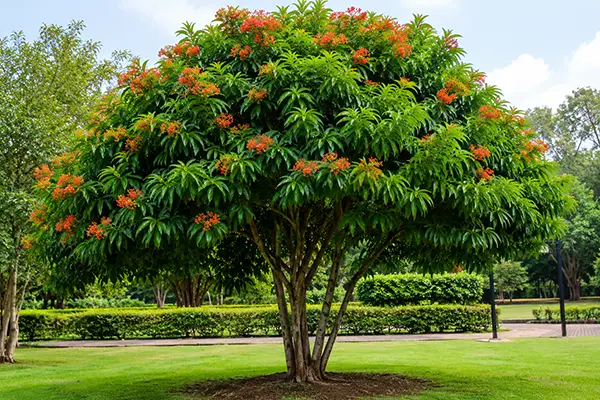
Ashok tree is simply known as the ashoka tree in English. It is native to the Indian subcontinent, particularly in regions of India, Nepal, Sri Lanka, and Bangladesh. It is a perennial that grows about 9-12 meters in height.
Let’s see ashoka tree scientific name, hardiness zones, family, and growth habit:
| Scientific name | Saraca asoca |
| Order | Fabales |
| Family | Fabaceae |
| Genus | Saraca |
| Hardiness zones | USDA zones 10-12 |
| Native Range | India, Nepal, Sri Lanka, and Bangladesh |
| Common names |
|
| Maintenance | Low |
| Growth Habit | Spreading canopy and weeping foliage |
| Lifespan | Perennial |
| Height | 9-12 meters |
| Best Season to Grow | Spring |
Key Features and Benefits of Ashoka Tree
The Ashoka tree is popular due to its dense foliage, orange-red flower clusters, and beautiful flat pods. This perennial is highly beneficial for its medicinal value, year-round beauty, and environmental advantages.
Let’s take a closer look at ashoka tree benefits and key features:
Key Features of Ashok Tree
- Leaves: The leaves of this tree start with a soft copper red shade and mature into deep, rich green. This dense growing foliage makes the tree look lush and fuller.
- Flowers: It produces clusters of blooms, making the tree even more eye-pleasing. Interestingly, these flowers change colour from yellow to orange and deep red. February to April is the peak bloom season when the tree brings warmth and charm to the landscape.
- Fruits and Seeds: Over time, this tree produces leathery black pods as fruit containing its seeds. These seeds are used to propagate new trees.
Benefits of Ashok Tree
- Medicinal Value: In Ayurvedic medicine, the bark, leaves, flowers, and seeds have been used for various ailments. The parts of the ashoka plant support skin health, reduce inflammation, and improve menstrual well-being.
- Ornamental Value: The tree has great aesthetic value and is often planted for decorating pathways, lining boundaries, and creating natural privacy screens. It is commonly seen in parks, gardens, and along roadsides due to its shade-providing, dense canopy.
- All-Year-Round Beauty: One of the best things about this plant is that it provides year-round beauty to the landscape. The tree’s leaves stay green throughout the year. Between February and April, it blooms with orange-red flower clusters. After that, it produces the pods that add to its charm.
- Environmental Value: Ashoka maram offers food and habitat for many birds, insects, and mammals. Its thick foliage reduces noise pollution and provides cool shade in urban areas. This tree has an extensive root system that holds the soil and prevents erosion.
Did you know?
Saraca asoca has been documented in the ancient Ayurvedic text Charaka Samhita, noting its effectiveness in skin-related ailments due to being analgesic and astringent.
Scientific Take
The 2024 study by Research Journal of Pharmacy and Technology highlights that the extracts of Saraca asoca have wound-healing and anti-diabetic potential.
How to Plant an Ashoka Tree
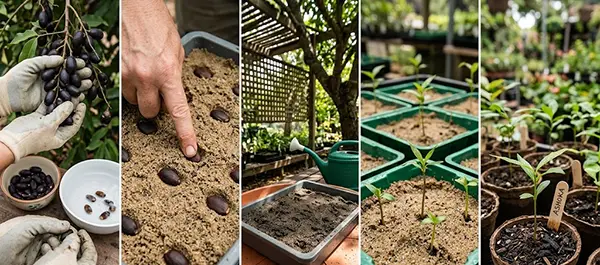
You can grow asoka maram from seeds by germinating them in sand and later transplanting them in organic soil. The seeds can be obtained from the fruits of a 6- to 8-year-old tree or bought from the nursery.
Here are the steps to plant an ashoka ped:
- Collect the fruits, the purple-black pods. Extract the seeds from them and rinse them well. Soak the seeds in water overnight.
- Press the seeds about 1 inch deep into the construction sand.
- Keep the sand well moist and place it in a semi-shaded spot.
- Within 15-25 days, the seeds will germinate.
- Transplant the seedlings into a mix of soil and compost.
Pro Tip
During soaking, check the quality of the seeds. Floating seeds are usually empty; throw them away and keep the ones that sink.
For faster results, you can buy the saplings online. It helps skip the seed germination step and has a higher success rate. To know how to buy a sapling, refer to how to choose healthy saplings online: a complete buyer’s guide.
Growing Conditions of Ashoka Tree
To grow Saraca asoca, you should select a spot with full sun and well-draining organic soil. These perennials are drought-tolerant once established, so they need moderate watering. Also, do occasional pruning, feeding, and mulching to encourage new growth.
Sunlight Needs
Ashok gach can be grown in full sun to partial shade. Ideally, it needs more than 6 hours of direct daily sunlight. Full sun is best for abundant flowering and faster growth. Though it is tolerant of partial shade, giving you flexibility to locate it.
If you are growing the small ashoka tree in a pot on a balcony or terrace, it’s best to position it in the spot where it gets morning and afternoon sunlight without being blocked by buildings or trees.
Watering Frequency
Water the young trees and potted plants regularly, especially in their active growing season from spring through autumn. Ensure that the soil is well moist but not waterlogged. Reduce the watering intake in established Ashok gach; it is drought-tolerant and requires moderate watering. In winter, water the plant occasionally, as its growth is much slower.
Soil Needs
The Ashok ped requires well-draining organic soil to grow well. Use fertile loamy soil that is slightly acidic to neutral. Avoid heavy clay soil that retains too much water and, as a result, leads to root rot. If your site has clay soil, consider amending it with organic matter before planting.
Fertilizers
This is not a heavy feeder. Apply a balanced organic fertilizer or well-rotted compost once or twice a year (preferably once in its growing season of spring and early summer). Don’t use nitrogen fertilizer excessively, as it can lead to soft growth that is susceptible to pests.
Pruning and Mulching
After the flowering season of April and May, trim the ashoka plant lightly to encourage new growth and improve its structure. Apply a 2-3 inch layer of organic mulch around the tree, including composted bark and dried leaves. This retains moisture and regulates soil temperature.
Temperature and Humidity
The tree grows best in the temperature range of 20–35°C. It is sensitive to frost in colder regions and should be provided with winter protection. The tree prefers high humidity levels due to its rainforest habitat. However, it is tolerant of dry conditions if provided with proper moisture.
Pro Tip
You may plant the young ashoka plant in a pot of about 18-24 inches in diameter. It is a pot-friendly plant to be kept on patios and terraces where limited space is available.
Scientific Take
A 2023 study by the Journal of Ethnopharmacology highlights the value of Saraca asoca as an herbal drug. It concludes with a call for conservation efforts to protect it as a medicinal plant.
Propagation Method of Ashoka Tree
The Asoka tree is easily propagated using its seeds (steps mentioned above!), while it can also be grown through stem cuttings. You can do this by rooting a healthy branch under the right growing conditions.
Let’s see the steps to propagate the asoka tree:
- Select healthy semi-hardwood branches with a thickness of about 0.5 to 1.5 cm.
- Dip the base of the cutting in the rooting hormone for better results.
- Place the cutting in well-draining soil; maintain moisture and partial shade to support root development.
Types of Ashoka Tree
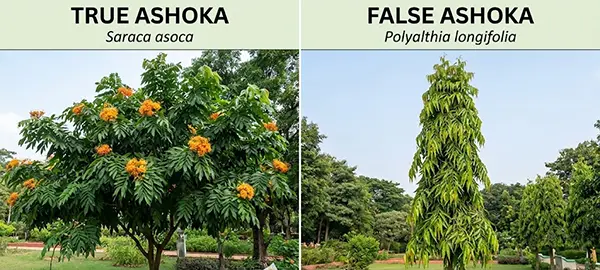
Many people tend to confuse the true ashoka (Saraca asoca) and the false ashoka (Polyalthia longifolia). The false ashoka is called arana maram in Malayalam, and it is significantly different from true ashoka based on their appearance, flowers, and uses.
Let’s see the differences between the true and false ashoka tree botanical names, appearances, families, and uses:
| Feature | True Ashoka (Saraca asoca) | False Ashoka (Polyalthia longifolia / Debdaru) |
| Family | Fabaceae | Annonaceae |
| Appearance | A small spreading evergreen tree with a rounded canopy and tender pinkish-red new leaves | A tall, straight, columnar tree that looks like a Mediterranean cypress |
| Flowers | Mildly fragrant, bright orange-red clusters | Small star-shaped green flowers with no fragrance |
| Uses | Considered highly sacred in Hindu and Buddhist traditions and valued in Ayurveda | Planted in rows along driveways and boundaries as a privacy screen. However, it does not have any sacred or medicinal value |
The choice of the tree depends on your requirements: if you want cultural and ornamental value, plant true ashoka, and if you wish for a low-maintenance structure and privacy, then go for false ashoka.
Pro Tip
You may plant both the true ashoka and false ashoka in the landscape for the combination of beauty and structure.
Common Problems in Ashoka Trees
Ashoka trees can suffer from common issues like yellowing leaves, pest infestations, root rot, and powdery mildew. These issues can cause damage to the ashoka tree leaves and other parts, but they are easy to treat.
- Pest infestation: Mealybugs and scale insects can cause damage to the asok tree, especially in warm and humid weather. For scale insects and mealybug treatment apply neem oil.
- Root rot: Root rot can be caused by waterlogging, particularly during the heavy monsoons. To prevent this, reduce watering and ensure good drainage.
- Yellowing leaves: It can happen due to poorly drained, compacted soils. Improve the drainage and aeration in the soil by adding organic matter to the soil.
- Slow growth: Caused by insufficient light or poor soil. Ensure that the tree is planted in enriched, well-draining soil and receives adequate sunlight.
- Powdery mildew: It looks like a white powdery layer on the leaves. To treat it, remove the heavily infected leaves and spray diluted neem oil.
Bottom Line
The Ashoka tree undoubtedly has significant visual appeal and cultural relevance. It has fragrant, nectar-rich flowers and an overall elegant appearance to build a pollinator friendly garden.
Whether you want a meaningful plant for pots or something elegant for the garden, the ashoka tree is an ideal one for you. By keeping it under the right growing conditions, you can grow this plant without making things complicated.
What is ashoka botanical name?
It is scientifically known as Saraca asoca.
What is the family of ashoka trees?
This tree belongs to the Fabaceae, or legume, family.
oes ashoka thetti flower?
Yes! The tree blooms with yellow-orange flower clusters from February to April.
What do you call the Ashok tree in English?
Ashoka tree english name is simply ashoka tree, which translates to the sorrowless tree.
Can an Ashoka tree grow in pots?
Yes! Young ashoka trees can be planted in large pots. However, as the tree grows, it should be shifted directly to the ground. If you want to keep it longer in a container, then do regular pruning to maintain its structure.
- Medical application of Ashok tree (Saraca asoca): A review – ResearchGate
- Phytochemical screening of Saraca asoca (Ashoka tree) – International Journal of Research in Agronomy
- Saraca asoca (Roxb.)Willd. – India Biodiversity Portal
- Pharmacological Importance of Saraca asoca: A Review – Research Journal of Pharmacognosy and Phytochemistry